
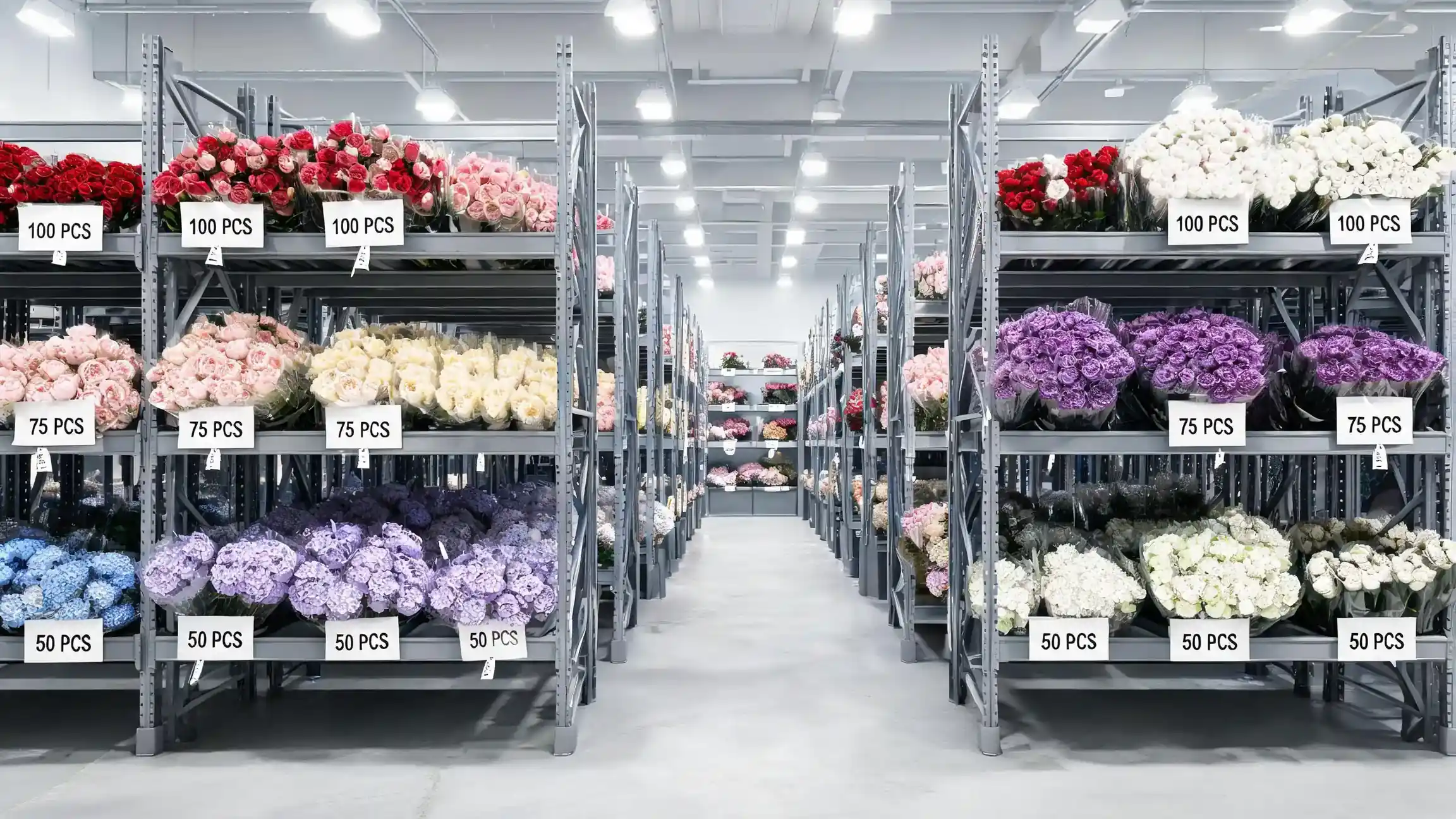
Understanding MOQ for Artificial Flowers: A B2B Buyer’s Guide
Indeed, Minimum Order Quantity (MOQ) is one of the most misunderstood concepts in B2B sourcing. While many first-time buyers see MOQ as a barrier, experienced buyers recognize it as a strategic tool for cost optimization. Therefore, this guide explains everything you need to know about MOQ when buying wholesale artificial flowers from China.
Whether you’re a florist ordering wedding flowers, a retailer stocking silk flowers, or an event company sourcing individual stems in bulk, understanding MOQ helps you plan orders efficiently and negotiate better pricing.
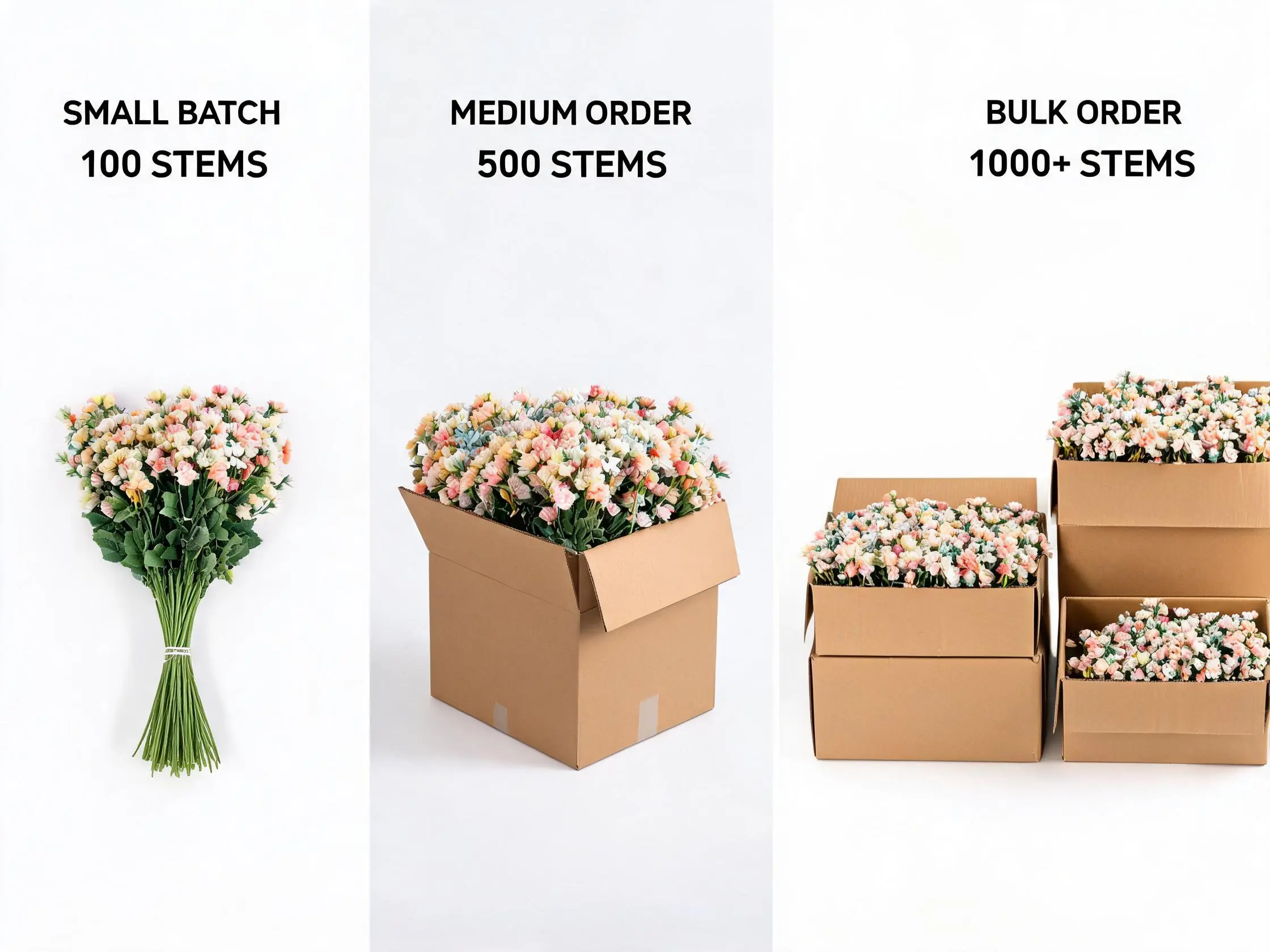 Visual comparison: small batch vs. medium order vs. bulk order
What Is MOQ and Why Does It Matter?
Specifically, MOQ (Minimum Order Quantity) is the smallest number of units a manufacturer will produce in a single order. For artificial flower manufacturing, MOQ exists for practical reasons:
- Production setup: Dye mixing, mold preparation, and machine calibration are fixed costs regardless of quantity. A 100-stem batch requires the same setup as a 10,000-stem batch.
- Material sourcing: Silk fabric, PU material, and wire are purchased in bulk rolls. Cutting small quantities wastes material and increases per-unit cost.
- Labor efficiency: Workers are most productive once they’re trained on a specific product. Small batches mean constant retraining.
- Quality consistency: Larger batches produce more consistent color and quality because dye lots and material batches are uniform.
Key Insight
Importantly, MOQ is not arbitrary — it reflects the manufacturer’s cost structure. Consequently, understanding this gives you leverage in negotiations. When you know why a manufacturer needs 1,000 stems, you can propose creative solutions that work for both parties.
Standard MOQ Tiers for Artificial Flowers
Generally, most manufacturers, including Hiway, structure MOQ in tiers. Naturally, higher quantities unlock better pricing:
| Order Tier | Quantity | Best For | Typical Discount | Lead Time |
|---|---|---|---|---|
| Sample Batch | 50-200 stems | Product evaluation, market testing | Base price (highest per-unit) | 7-15 days |
| Entry Wholesale | 500-1,000 stems | Small retailers, new B2B buyers | 10-20% off sample price | 15-25 days |
| Standard Wholesale | 1,000-5,000 stems | Established retailers, event companies | 25-35% off sample price | 20-30 days |
| Bulk Order | 5,000-10,000 stems | Distributors, large wholesalers | 40-50% off sample price | 25-35 days |
| Container Load | 10,000+ stems | Importers, national distributors | 50-60% off sample price | 30-45 days |
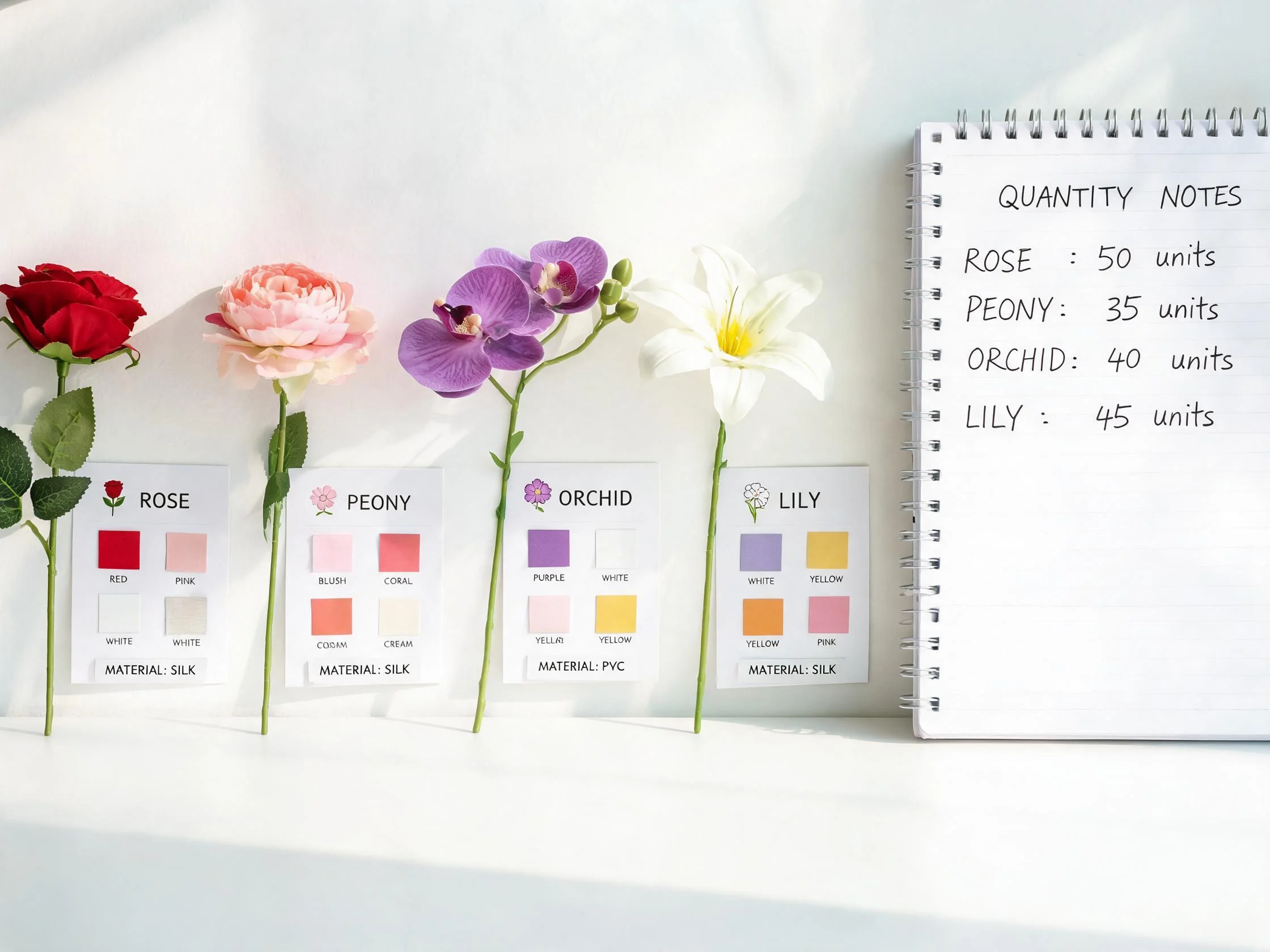 Sample evaluation is the first step before committing to MOQ orders
MOQ by Product Type
Furthermore, MOQ varies significantly by product complexity. Here’s what to expect:
Standard Products (In-Stock Designs)
- Standard artificial plants and flowers: 500-1,000 stems
- Common colors (white, pink, red): lower MOQ of 500 stems
- Seasonal colors (burgundy, navy): MOQ of 1,000 stems
Custom OEM Products
- Custom colors (Pantone matching): 1,000-2,000 stems per color
- Custom bloom sizes or shapes: 1,000-3,000 stems
- Custom packaging or private label: 500-1,000 units
- Full custom design (new mold): 3,000-5,000 stems
Additionally, for a deeper dive into the OEM process, see our OEM/ODM services page.
How to Calculate Your True Cost Per Unit
Notably, many buyers focus on the unit price from the manufacturer and forget to calculate the true landed cost. Here’s the formula:
True Cost Per Stem Formula
True Cost = (Product Cost + Shipping + Customs + Inspection + Defect Allowance) / Total Stems
Example (1,000 stems):
Product: $1.50/stem = $1,500
Shipping (sea, FOB-Qingdao): $0.20/stem = $200
Customs (US, 0% duty): $0
Inspection: $0.05/stem = $50
Defect allowance (3%): $0.045/stem = $45
True cost = $1.795/stem
Pro Tip: Compare your true cost at different MOQ levels. The per-unit savings from higher MOQ may be significant — but only if you can sell or store the excess inventory. Don’t order 10,000 stems to save $0.30/stem if you’ll only sell 2,000 this year.
How to Negotiate MOQ
Fortunately, MOQ is almost always negotiable, especially for first-time orders. Here are proven strategies:
Strategy 1: Request a Trial Order
Most manufacturers will accept 30-50% of their standard MOQ for a first order. Frame it as a quality test: “I want to verify your quality before committing to full MOQ.” This is standard practice and most factories will agree.
Strategy 2: Group Products by Material
Alternatively, if a manufacturer’s MOQ is 1,000 stems but you only need 300 roses and 300 peonies, ask if you can combine them to reach 600 stems. Often, many manufacturers will accept this if both products use the same base material (silk, PU, etc.).
Strategy 3: Share a Production Slot
Moreover, if you have a network of buyers, coordinate to share a production run. This works well for trade associations and buying groups. Consequently, the manufacturer gets their full MOQ, and each buyer gets a smaller quantity.
Strategy 4: Offer to Pay a Premium
Finally, if you absolutely need a small quantity, offer to pay 15-25% above the standard unit price. In this case, the manufacturer recovers their setup costs, and you get the quantity you need. Ultimately, this is often cheaper than buying from a trading company.
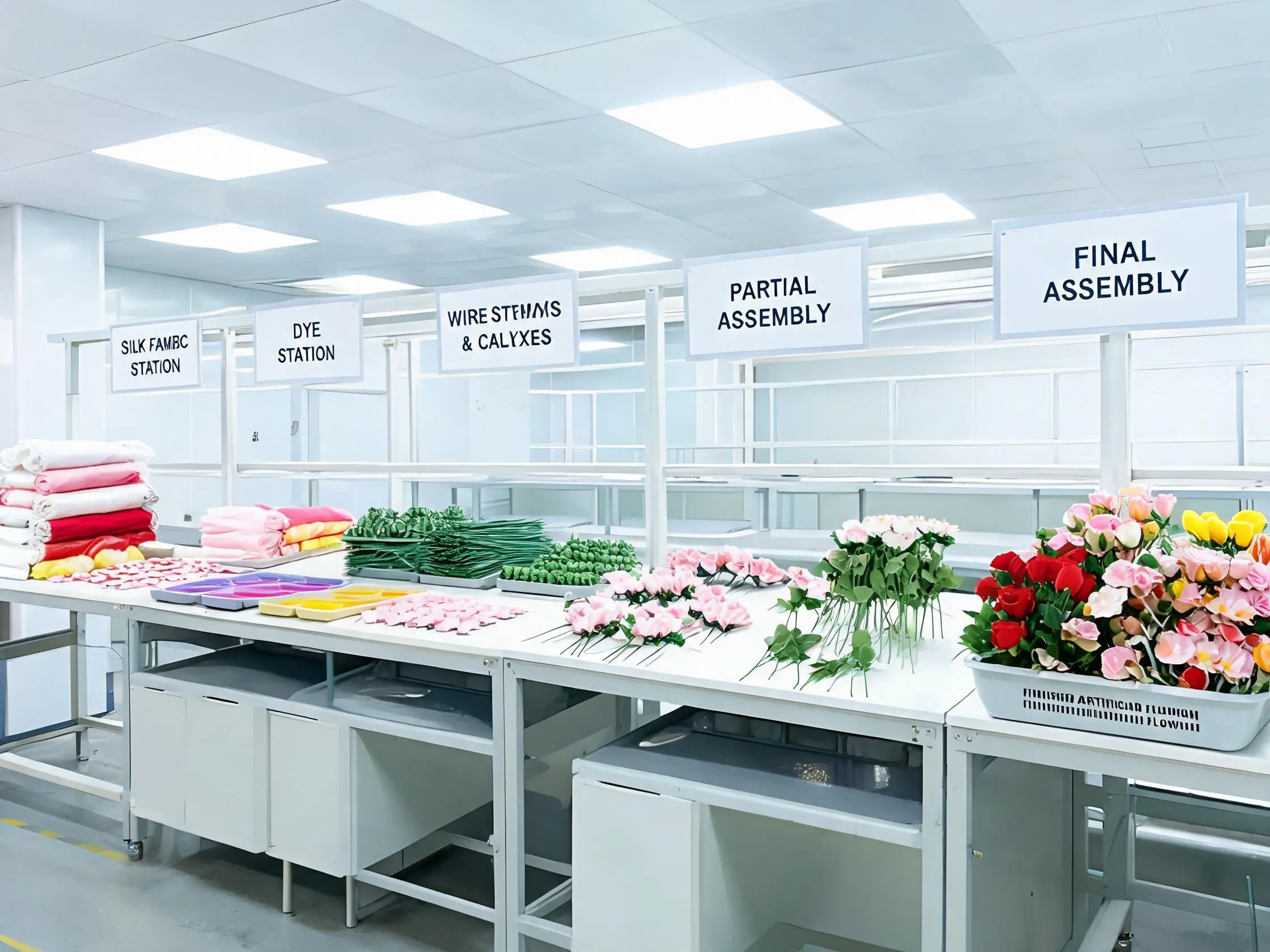 Understanding the production process helps you negotiate MOQ effectively
MOQ for Different Business Types
| Business Type | Recommended Starting MOQ | Why |
|---|---|---|
| Online Retailer | 500 stems | Test market demand before committing to larger orders |
| Brick & Mortar Store | 1,000 stems | Need display volume and backup stock |
| Wedding/Event Planner | 1,000-2,000 stems | Need rental inventory across multiple events |
| Florist/Flower Shop | 500-1,000 stems | Supplement fresh flowers with permanent stock |
| Hotel/Hospitality | 1,000-3,000 stems | Decorate multiple rooms and common areas |
| Distributor/Importer | 5,000-10,000 stems | Maximize margin through bulk pricing |
Common MOQ Mistakes to Avoid
- Ordering at exact MOQ with no buffer: Always order 5-10% above MOQ to cover defects, damage, and returns. Running out of stock mid-season is far more expensive than slightly over-ordering.
- Ignoring storage costs: A 10,000-stem order saves $0.30/stem but requires 200+ sq ft of storage. Calculate warehouse cost before committing to bulk MOQ.
- Not understanding color MOQ: MOQ usually applies per color, not total. 1,000 stems in 5 colors = 5,000 stems total. Clarify this before ordering.
- Paying 100% upfront for large MOQ: Standard terms are 30% deposit, 70% before shipment. Never pay 100% upfront, especially for large orders.
- Not factoring in lead time for large MOQ: A 10,000-stem order takes 30-45 days, not 15 days. Plan your ordering calendar accordingly.
Conclusion
In summary, understanding MOQ is fundamental to profitable B2B sourcing. The key takeaways: MOQ reflects real production costs, higher tiers unlock significant discounts, and MOQ is almost always negotiable for first orders or through creative grouping strategies.
Therefore, start with a trial order at 30-50% of standard MOQ, prove the quality and market demand, then scale up to full MOQ for better pricing. Ultimately, this approach minimizes risk while building toward long-term volume savings.
Ready to discuss your MOQ needs? Contact Hiway for a personalized quote. Specifically, we offer flexible MOQ options for new B2B clients and can structure orders to match your business scale.