Planning your wedding flowers and torn between real-touch and silk? You are not alone. Every bride wants blooms that look fresh, photograph beautifully, and survive a long day of hugging, dancing, and posing — without the wilting, browning, and pollen allergies that come with fresh-cut stems. In this guide, we break down the two most popular artificial flower materials so you can choose with confidence.
When it comes to wedding artificial flowers, the material you choose matters more than the flower type itself. A well-made real-touch peony can outshine a mediocre silk rose, while a premium silk hydrangea might be the better pick for a lush tablescape. So let’s settle the debate: real-touch vs silk wedding flowers — which material truly looks more real?
What Are Real-Touch Wedding Flowers?
Real-touch flowers are the pinnacle of modern artificial bloom technology. Unlike traditional fabric flowers, real-touch varieties are crafted using a specialized polyurethane (PU) or latex coating applied over a fabric or foam core. This coating replicates the cellular structure, moisture content, and thermal feedback of natural petals — meaning when a guest accidentally brushes against your real-touch rose, it feels cool and soft, just like a fresh bloom.
The magic lies in the material science. When you gently squeeze a real-touch petal, it compresses and then slowly springs back over 2–3 seconds, mimicking the delayed recovery of real petal tissue. Silk fabric, by contrast, simply folds and snaps back instantly — a dead giveaway that it is artificial. This subtle tactile difference is what separates a bouquet that fools everyone from one that screams “fake.”
For wedding bouquets, this matters enormously. Your bridal bouquet will be held, passed around, and photographed at close range for hours. Real-touch flowers hold up to all of that while maintaining the illusion of freshness from the first photo to the last dance.
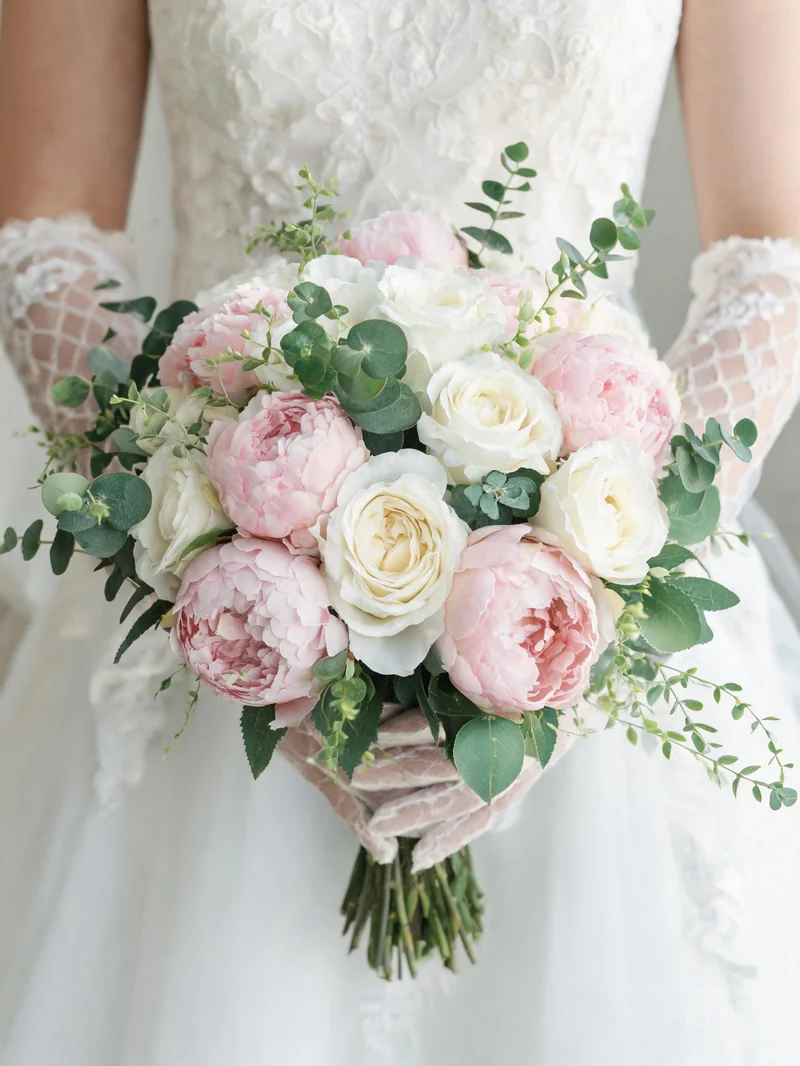
A premium bridal bouquet — real-touch peonies and silk roses combined for maximum realism.
What Are Silk Wedding Flowers?
Silk wedding flowers are the classic choice — and despite the name, most modern “silk” flowers are actually made from high-grade polyester woven to mimic the drape and sheen of natural silk. The fabric is cut into petal shapes, dyed with color gradients, and assembled around wired stems that allow you to pose each bloom. Premium silk flowers feature hand-painted details, multi-layer construction with 30–60+ petals per bloom, and matte finishes that reduce the plastic-like shine of cheaper alternatives.
While silk flowers may not replicate the soft, fleshy feel of real petals as convincingly as real-touch varieties, they excel in other areas. They are lightweight, available in virtually any color and variety, and — crucially — more affordable. For couples planning large weddings with extensive floral decor (ceremony arches, aisle runners, table centerpieces, flower walls), silk flowers offer the volume and variety needed without breaking the budget.
You can explore our full range of silk flowers to see the quality and variety available.
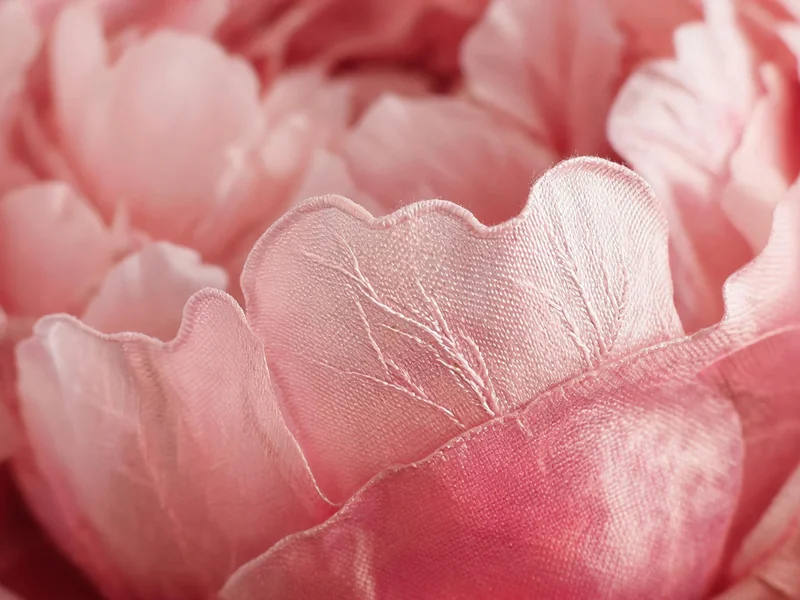
Premium silk flowers feature hand-painted color gradients and multi-layer petal construction.
Material Composition: What Makes Them Different?
The fundamental difference between real-touch and silk flowers comes down to chemistry and manufacturing process:
Real-Touch (PU / Latex) Flowers
A fabric or foam petal base is dipped in liquid polyurethane or latex. As the coating cures, it forms a thin, flexible membrane that replicates the translucency, surface tension, and thermal properties of real petal tissue. The result is a flower that feels cool, slightly tacky, and soft — with the same “give” as a living bloom. Because the surface is molded rather than woven, it can replicate the microscopic ridges, veins, and irregular textures that real flowers possess.
Silk (Polyester Fabric) Flowers
Polyester fabric is silk-screened with dye to create color gradients, then die-cut into petal shapes. The petals are assembled around a plastic or wire stem, often with a stamen detail in the center. The fabric surface is smooth and matte (in premium varieties) or slightly shiny (in budget versions). Silk flowers can be shaped by bending the internal wire, but the material itself has no “memory” — it does not compress and recover like real petals do.
Real-Touch vs Silk: Side-by-Side Comparison
Here is an objective, feature-by-feature comparison to help you evaluate which material suits your wedding needs:
Comparison data synthesized from multiple artificial flower industry sources and manufacturer specifications.
Which Material Looks More Real? The Verdict
If we are judging purely on visual and tactile realism — real-touch flowers win. The polyurethane coating creates a surface that interacts with light the same way real petals do: it is slightly translucent, matte rather than shiny, and possesses the subtle surface texture (ridges, veins, microscopic irregularities) that our brains associate with living tissue. Under professional wedding photography, especially macro ring shots and close-up bouquet portraits, real-touch flowers are virtually indistinguishable from fresh blooms.
That said, premium silk flowers are not far behind. In a large reception hall viewed from 10 feet away, even a trained florist would struggle to tell the difference between a high-end silk hydrangea centerpiece and a fresh one. The gap narrows dramatically at distance — and disappears entirely in group photos taken from across the room.
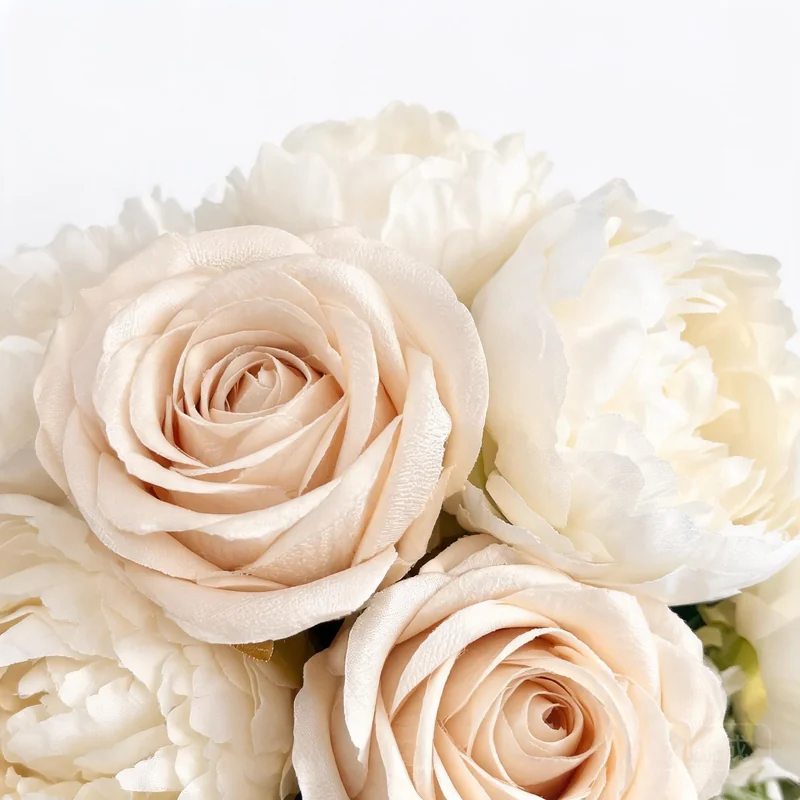
Close-up detail showing realistic petal texture — the hallmark of premium artificial wedding flowers.
The smartest approach? Use both. Many professional florists now create hybrid bouquets and arrangements that pair real-touch hero flowers (roses, peonies) with silk filler blooms (hydrangeas, greenery, baby’s breath). This gives you the best of both worlds: maximum realism where it matters most, and cost-effective volume where it does not. Explore our product catalog to mix and match varieties.
Durability and Weather Resistance
Wedding flowers face a gauntlet of challenges: outdoor ceremonies in summer heat, humid greenhouses, accidental spills, and hours of handling. How do the two materials hold up?
Real-touch flowers have a clear advantage outdoors. Their non-porous PU surface does not absorb moisture, meaning they survive light rain, high humidity, and even accidental dips in water without sagging or color bleeding. The coating also provides better UV resistance, so colors stay true longer in sunlight.
Silk flowers, being fabric-based, are more vulnerable to moisture. In humid or rainy conditions, the fabric can absorb water, become limp, and even bleed dye. However, for indoor weddings or short outdoor ceremonies, this is rarely a practical issue. Premium silk flowers treated with UV-resistant coatings can also hold their color well in covered outdoor spaces.
For long-term keepsakes — because yes, many couples preserve their wedding bouquets — both materials last 3–5+ years with proper care, though real-touch flowers tend to retain their shape and color slightly better over time.
Cost Comparison: Real-Touch vs Silk
Budget is a decisive factor for most couples. Here is the reality:
- Real-touch flowers typically cost 30–60% more per stem than equivalent silk varieties, due to the more complex manufacturing process (dipping, curing, hand-finishing).
- Premium silk flowers offer the best value-to-volume ratio. For large installations like ceremony arches, flower walls, and aisle decor, silk is often the only practical choice at scale.
- Hybrid approach — using real-touch for the bridal bouquet and close-up table centerpieces, silk for everything else — delivers maximum impact for 60–70% of the cost of an all-real-touch wedding.
For wholesale buyers and event planners, the savings compound. Contact us through our contact page for bulk pricing on both materials.
Best Flower Varieties for Each Material
Not every flower type benefits equally from each material. Here is a quick guide to help you choose the right material for each variety:
Best in Real-Touch
- Roses — the fleshy, layered petals of real roses are perfectly replicated by PU coatings
- Peonies — the ruffled, voluminous petals and subtle translucency shine in real-touch
- Calla lilies — the smooth, waxy surface of calla lilies is practically identical in PU
- Tulips — the glossy, cupped petals benefit from real-touch’s moisture-mimicking surface
- Magnolias — the thick, leathery petals are naturally suited to latex coatings
Best in Premium Silk
- Hydrangeas — the mass of small, clustered petals is better served by lightweight silk
- Orchids — the intricate, papery petals and arching sprays work well in fine polyester
- Lavender — the delicate, tiny blooms on slender stems are impractical to mold in PU
- Baby’s breath and filler — the sheer volume needed makes silk the only sensible choice
- Greenery and foliage — leaves, ferns, and eucalyptus are excellent in silk for cost efficiency
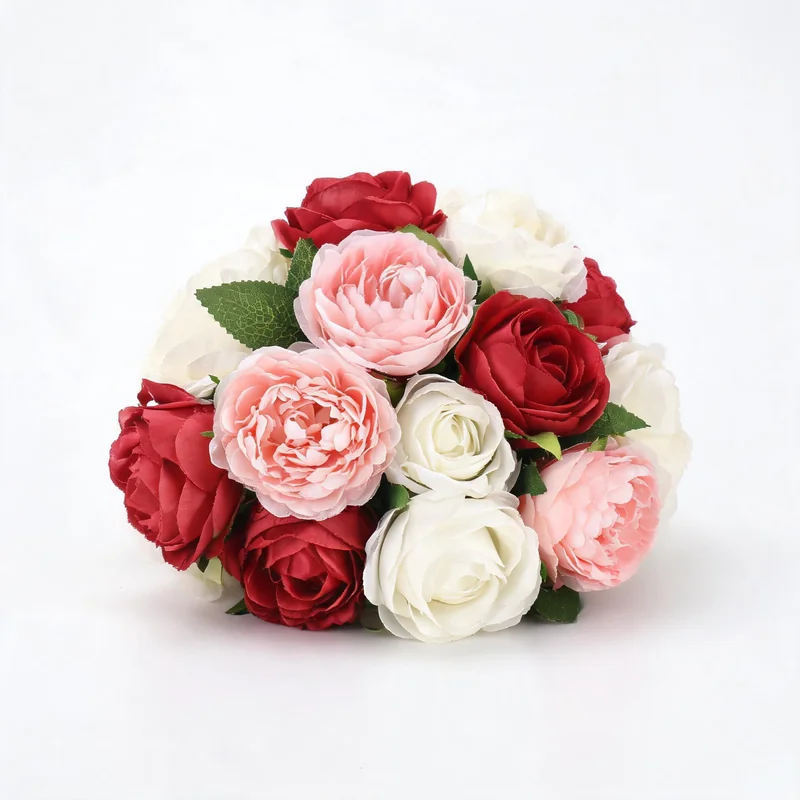
Roses and peonies — available in both real-touch and premium silk from our silk flower collection.
How to Choose the Right Material for Your Wedding
Still undecided? Use this quick decision framework:
Choose Real-Touch If You:
- Want maximum realism for close-up photography (bridal portraits, ring shots)
- Are having an outdoor wedding where flowers may face heat, humidity, or light rain
- Plan to preserve your bouquet as a long-term keepsake
- Have guests with severe pollen allergies who will be in close contact with the bouquet
- Are working with a premium budget and want the absolute best
Choose Silk If You:
- Need large quantities of flowers for arches, walls, and aisle decor
- Want specific color matches that are easier to achieve with dyed fabric
- Prefer lighter-weight arrangements (silk is significantly lighter than PU-coated stems)
- Are planning an indoor wedding where weather resistance is not a concern
- Want the best value for your floral budget
Choose Both (Hybrid) If You:
- Want real-touch hero flowers in the bridal bouquet and premium silk for everything else
- Need to balance budget without sacrificing the moments that matter most
- Are working with a florist who understands how to blend the two materials seamlessly
Our wedding flower packages offer both materials with full OEM and ODM customization — so you can specify exactly which varieties use real-touch and which use silk.
Frequently Asked Questions
Are real-touch flowers more expensive than silk flowers?
Yes, real-touch flowers typically cost 30–60% more per stem due to the more complex polyurethane dipping and curing process. However, the hybrid approach — real-touch for the bridal bouquet and silk for bulk decor — keeps costs manageable while maximizing realism where it counts.
Can guests tell the difference between real-touch and fresh flowers?
In most cases, no. Real-touch flowers are designed to replicate the tactile, visual, and even thermal properties of fresh petals. The surface feels cool and slightly soft, mimicking natural moisture. Even at close range, most guests — and many florists — cannot distinguish premium real-touch blooms from fresh ones.
Do silk flowers look fake in wedding photos?
Premium silk flowers with hand-painted gradients, multi-layer petal construction, and matte finishes photograph beautifully — especially in wide shots and group photos. The difference becomes more noticeable only in extreme close-up macro photography. For most wedding albums, premium silk flowers are virtually indistinguishable from fresh blooms.
Can I mix real-touch and silk flowers in the same bouquet?
Absolutely — and many professional florists recommend it. A hybrid bouquet might feature real-touch roses and peonies as the hero flowers, surrounded by silk hydrangeas, greenery, and filler blooms. This approach delivers maximum realism for the flowers that will be photographed most closely, while keeping the overall cost down.
How long do wedding silk and real-touch flowers last?
Both materials last 3–5+ years indoors with proper care. Real-touch flowers tend to retain their shape and color slightly better over time due to the protective PU coating. Either way, your wedding flowers can become a lifelong keepsake — something fresh flowers can never offer.
Conclusion: The Smart Choice for Your Wedding
The answer to “which material looks more real?” depends on how you define “real.” If you mean tactile realism — the feel of petals between your fingers, the cool softness of a bloom against your wrist — real-touch flowers are the clear winner. If you mean visual realism at a distance — the overall impression of a lush, abundant floral display — premium silk flowers come remarkably close, often at half the cost.
The wisest strategy for most couples is a hybrid approach: invest in real-touch flowers for the bridal bouquet, boutonnieres, and close-up table centerpieces where guests will see and touch them; use premium silk for ceremony arches, flower walls, aisle decor, and other large-volume installations where the difference is imperceptible from a distance.
Ready to design your perfect wedding flowers? Explore our complete range of wedding artificial flowers and silk flowers, or contact us for a custom quote tailored to your wedding palette and budget. Our OEM and ODM services mean we can create exactly what you envision — in the material that best suits each bloom.
Plan Your Wedding Flowers with Us
From real-touch bridal bouquets to silk ceremony arches — get wholesale pricing on premium wedding flowers. OEM and ODM customization available.
Request Your Free Quote