How to Find Reliable Artificial Flower Manufacturers in China
Indeed, finding a trustworthy artificial flower manufacturer in China is the single most important decision for your B2B sourcing strategy. The right partner delivers consistent quality, competitive pricing, and reliable lead times. Conversely, the wrong one costs you months of delays, defective products, and lost customers.
Drawing on 15+ years of manufacturing artificial flowers for global B2B clients, we’ve seen every mistake buyers make — and we’ve helped hundreds of new buyers avoid them. Therefore, this guide walks you through a proven 7-step process to identify, evaluate, and partner with a reliable Chinese manufacturer.
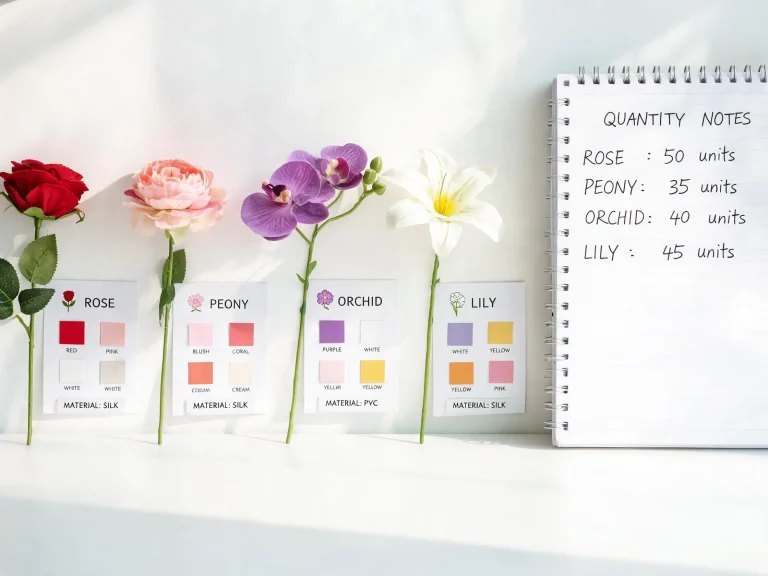
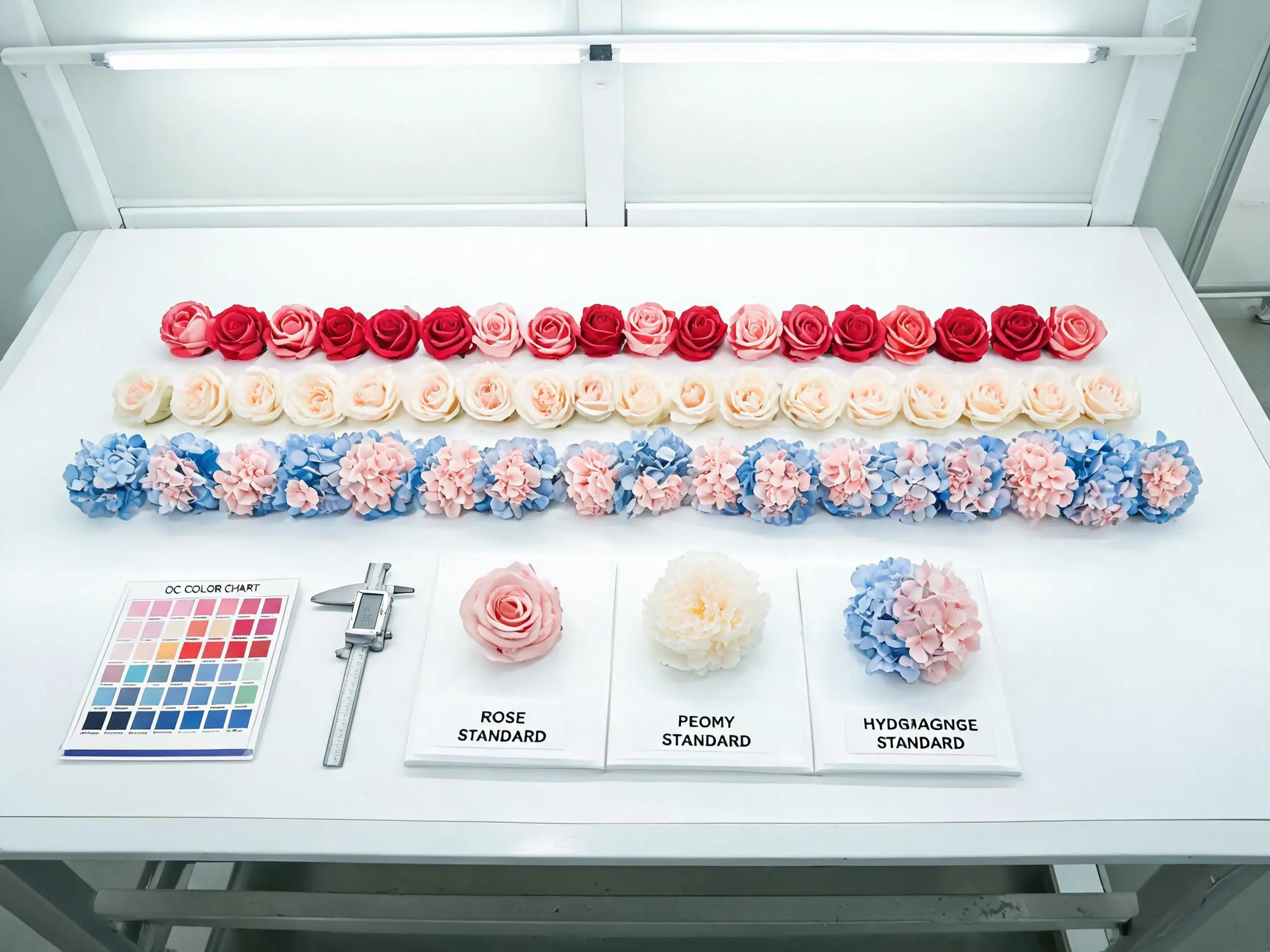 Quality control station with color charts and measurement tools
Why Manufacturer Selection Matters
Ultimately, your manufacturer relationship affects every aspect of your business: product quality, pricing margins, delivery reliability, and brand reputation. In fact, B2B buyers who partner directly with factories typically save 40-60% compared to working through trading companies or local distributors, as we detail in our complete wholesale buying guide.
However, price isn’t everything. A manufacturer who can’t deliver consistent quality across batches, meet lead times, or provide proper documentation will cost you far more than the savings.
Step 1: Define Your Product Requirements
First, before contacting any manufacturer, create a detailed product specification document. Specifically, the more detailed you are, the more accurate quotes and samples you’ll receive.
Your Spec Sheet Should Include:
- Flower types: roses, peonies, orchids, lilies, hydrangeas — or multiple types
- Materials: silk, PU real-touch, latex, plastic — each has different price points and realism levels
- Colors: Pantone codes or reference photos
- Sizes: bloom diameter, stem length, blooms per stem
- MOQ: your minimum order quantity
- Target price: your landed cost per stem
- Packaging: bulk, retail-ready, custom branding
- Certifications: REACH, RoHS, CPSIA if required
Need help deciding on materials? Read our real-touch vs silk comparison guide to understand the trade-offs.
Step 2: Search Through Verified Channels
Additionally, not all sourcing channels are equal. Here’s how to find legitimate manufacturers:
| Channel | Pros | Cons | Verification |
|---|---|---|---|
| Alibaba | Largest database, verified supplier tags | Mix of factories and trading companies | Look for “Verified Supplier” and “Gold Supplier” badges |
| Global Sources | Pre-vetted suppliers, trade show integration | Smaller selection | Check for “Verified Manufacturer” status |
| Made-in-China | Strong in manufacturing sector | Interface less intuitive | Look for “Audited Supplier” badges |
| Canton Fair | Meet face-to-face, see samples | Twice yearly, travel required | On-site verification |
| Direct Referral | Pre-vetted by trusted contacts | Limited options | Trust in referrer’s experience |
Red Flag: “Manufacturer” Who Isn’t Manufacturing
Importantly, many listings on B2B platforms claim to be manufacturers but are actually trading companies. Signs to watch for: extremely wide product ranges (roses AND electronics AND furniture), no factory address, no photos of production lines, and prices that seem too good to be true.
Step 3: Evaluate Manufacturer Credentials
Next, once you’ve identified potential manufacturers, evaluate them against these criteria:
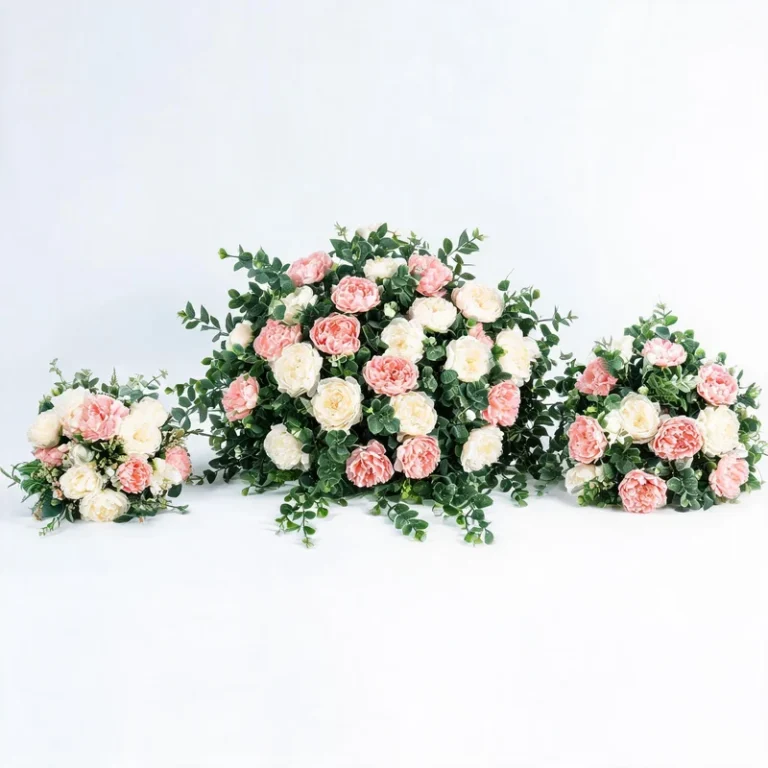
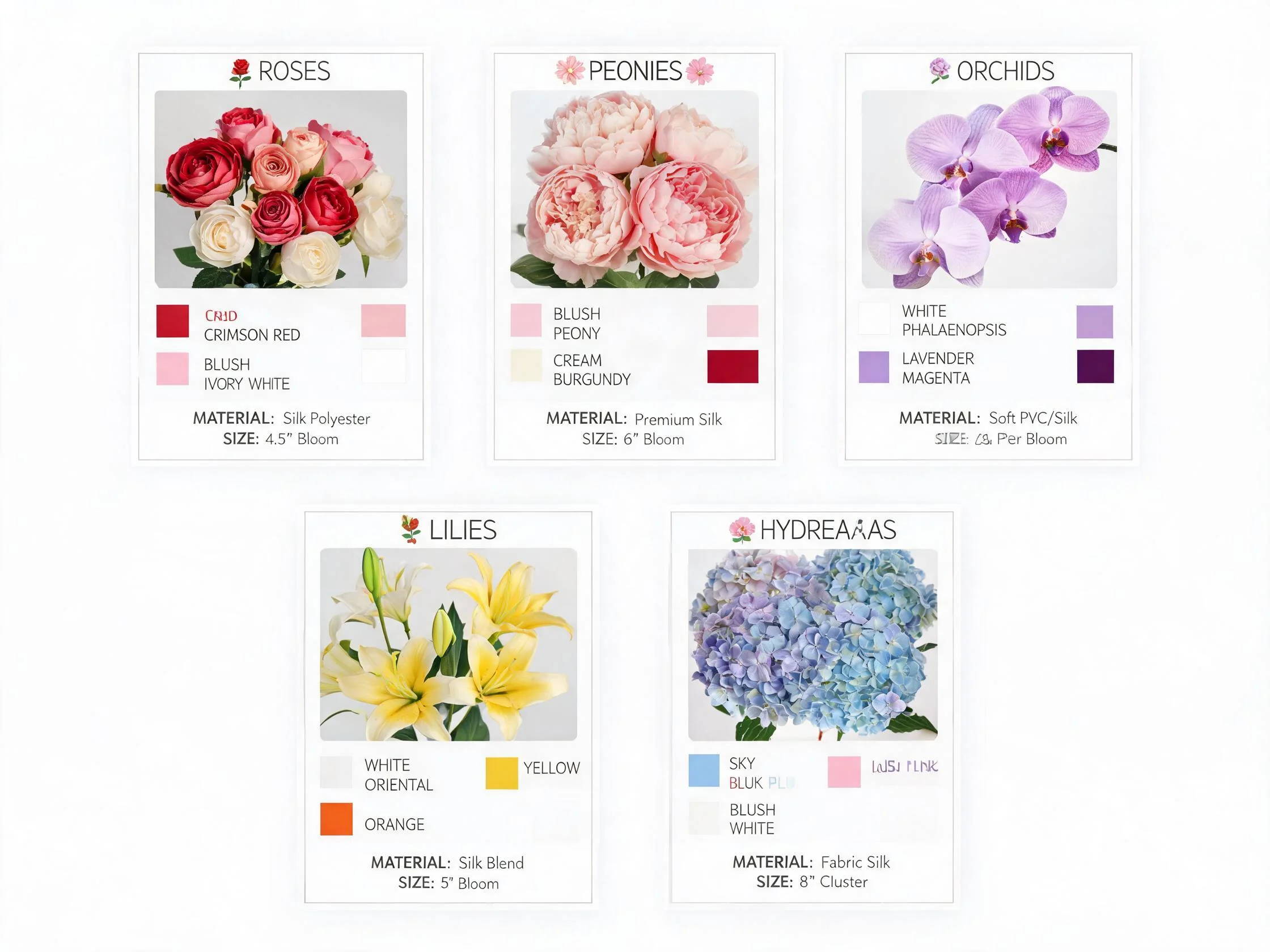 A professional product catalog demonstrates manufacturing capability
Business License and Export Qualifications
First, every legitimate Chinese manufacturer has a business license (营业执照) with a unified social credit code. Therefore, ask for a copy and verify it through the National Enterprise Credit Information Publicity System. Also check for Import/Export registration — without it, they can’t export directly and will use a trading company.
Factory Photos and Videos
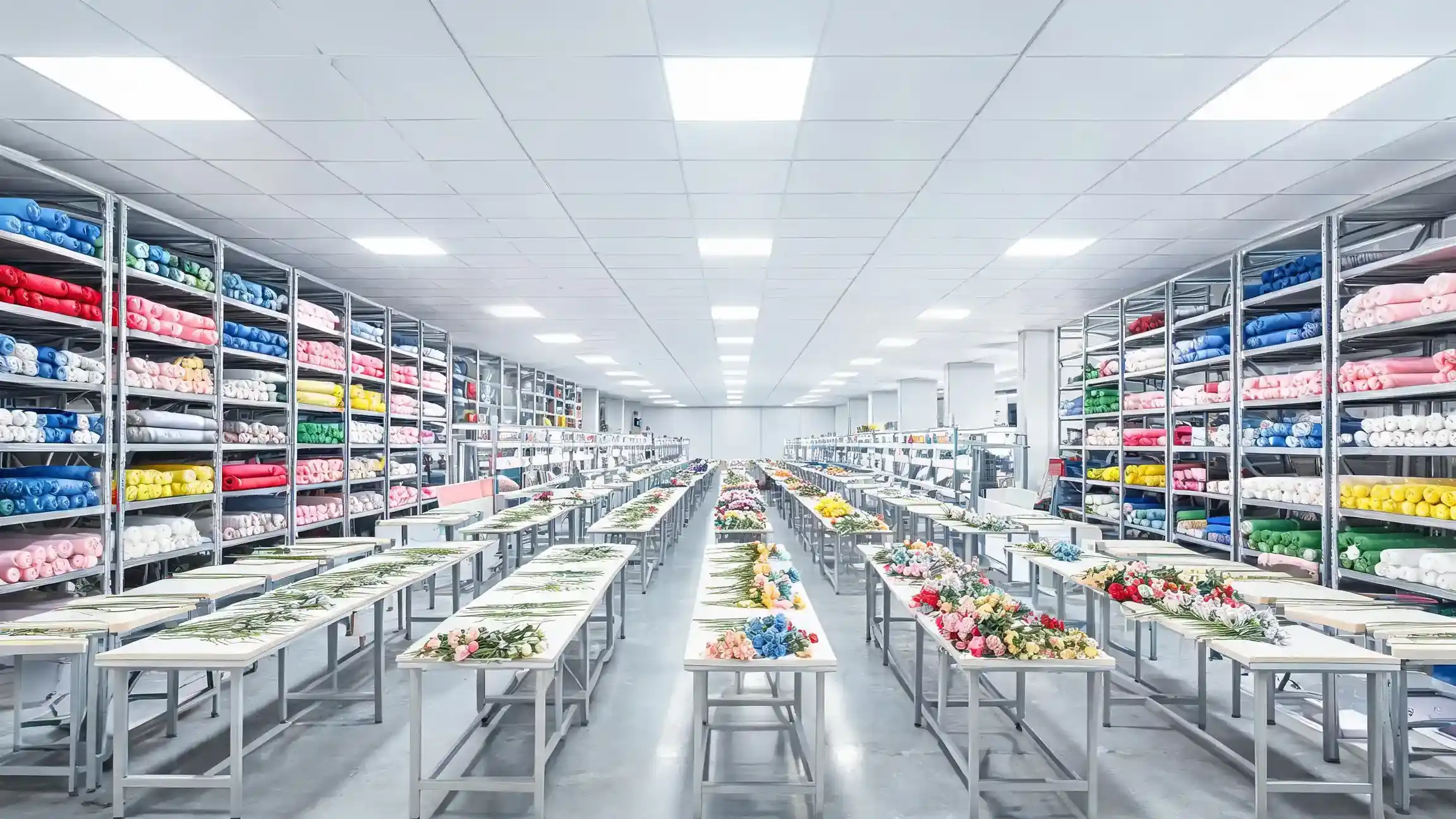
Additionally, request recent factory photos showing production lines, quality control stations, and warehouse facilities. If they hesitate or send stock photos, that’s a warning sign. In contrast, a real manufacturer will proudly show their facility — like our factory and company profile.
Certifications
Depending on your market, verify these certifications:
- REACH: Required for EU market — ensures chemical safety
- RoHS: If products contain electronic components (LED flowers)
- CPSIA: Required for products that may contact children in the US
- ISO 9001: Quality management system certification
- NFPA 701: Flame retardancy for commercial/hospitality use
Step 4: Request Samples
Importantly, never place a bulk order without first receiving and evaluating samples. This is non-negotiable.
Pro Tip: Order samples from 3-5 manufacturers simultaneously. Compare them side by side under the same lighting conditions. Take photos and notes. This head-to-head comparison reveals quality differences that photos alone cannot show.
When evaluating samples, check:
- Petal texture: Does it feel like fabric or plastic? Can you see the weave?
- Color accuracy: Does it match your Pantone reference under daylight?
- Construction: Are petals securely attached? Is the wire core flexible?
- Stem quality: Is the wrapping tight and realistic?
- Scent: High-quality artificial flowers should not have chemical odors
- Packaging: How are samples packed? This indicates shipping quality
Expect to pay $50-200 for samples including shipping. Some manufacturers, including Hiway, refund sample costs on your first bulk order.
Step 5: Assess Communication Quality
Furthermore, communication quality is the single best predictor of partnership success. A manufacturer who responds quickly, thoroughly, and proactively will be a reliable partner. Conversely, one who takes days to reply, gives vague answers, or disappears after you place an order will be a nightmare.
Green Flags:
- Responds within 24 hours on weekdays
- Provides detailed technical answers, not just price quotes
- Sends clear, well-lit photos of actual products
- Offers suggestions to improve your design or reduce costs
- Has English-speaking staff or professional translation
- Provides written quotes with itemized costs
Red Flags:
- Responses take 3+ days or are inconsistent
- Answers are vague (“yes we can do that” without details)
- Pushes for immediate deposit before providing specs
- Cannot answer technical questions about materials
- Only communicates via WhatsApp/WeChat with no email trail
Step 6: Conduct a Factory Audit
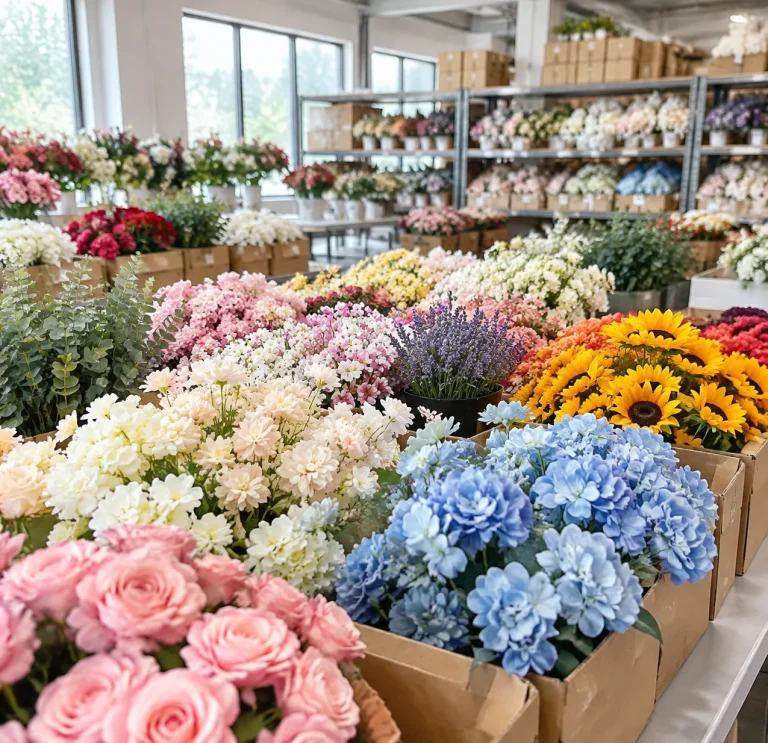
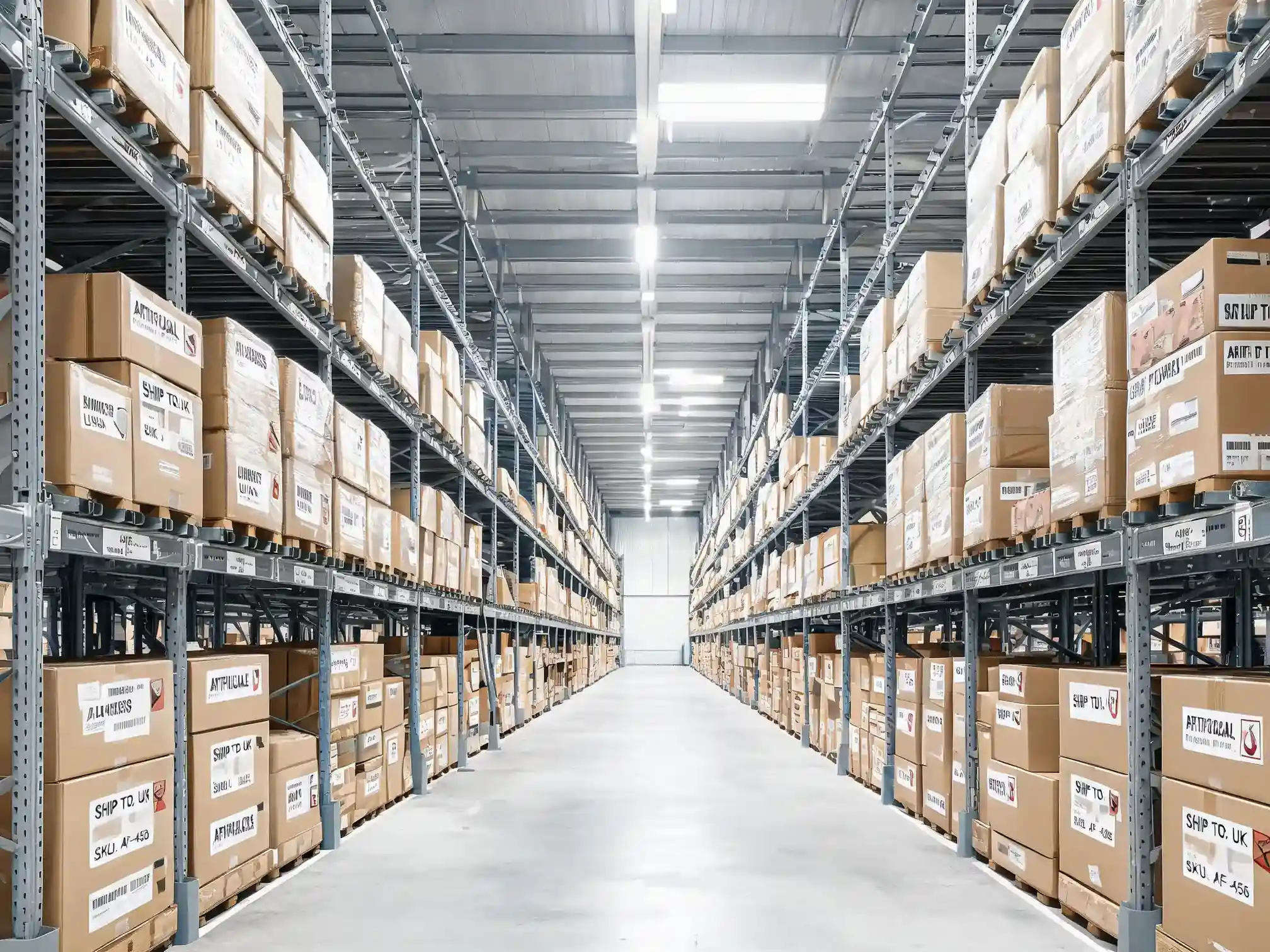 A well-organized export warehouse indicates professional operations
Moreover, for orders above $10,000, we strongly recommend a factory audit. You have two options:
Option A: Visit in Person
Specifically, visit the factory yourself. Check production lines, meet the team, see quality control in action, and review documentation. Naturally, this is the gold standard but requires travel time and cost.
Option B: Third-Party Audit
Alternatively, hire a professional inspection service (SGS, Bureau Veritas, Intertek, or a local Chinese agent) to conduct a factory audit on your behalf. Consequently, they’ll verify:
- Factory exists at the stated address
- Production capacity matches claims
- Quality control processes are documented and followed
- Working conditions and compliance
- Equipment and material storage conditions
In total, expect to pay $300-800 for a standard factory audit in China. Nevertheless, it’s worth every penny for serious B2B partnerships.
Step 7: Negotiate Terms and Place a Trial Order
At this point, you’ve done your research. Therefore, it’s time to start small and build trust.
Trial Order Strategy:
- Start with 30-50% of your target MOQ
- Use standard products first (not custom OEM) to test the process
- Specify every detail in a Purchase Order (PO) document
- Use trade assurance or escrow for first orders
- Request production photos at key stages
- Arrange pre-shipment inspection before final payment
Consequently, if the trial order goes smoothly — quality is good, lead time is met, communication is clear — then scale up to your full MOQ and consider OEM/ODM custom manufacturing for branded products.
Understanding MOQ: A Critical Factor
Additionally, Minimum Order Quantity (MOQ) varies dramatically between manufacturers. Understanding how MOQ works and how to negotiate it is crucial. For a detailed breakdown, read our companion guide on understanding MOQ for artificial flowers.
Typical MOQ ranges for artificial flowers:
- Standard products: 500-1,000 stems
- Custom colors: 1,000-2,000 stems
- Custom designs (OEM): 1,000-3,000 stems
- Custom packaging: 500-1,000 pcs
Common Mistakes to Avoid
- Choosing the cheapest quote: The cheapest manufacturer almost always cuts corners on materials, QC, or packaging. Price differences of 10-15% usually reflect real quality differences.
- Skip the sample stage: Ordering bulk without samples is the #1 cause of quality disputes. Always test first.
- No written contract: Verbal agreements are unenforceable. Use a detailed PO with specifications, QC standards, and acceptance criteria.
- 100% upfront payment: Standard terms are 30% deposit, 70% before shipment (or after inspection). Never pay 100% upfront to a new supplier.
- Ignoring incoterms: FOB, CIF, and DDP have very different cost structures. Understand which applies and factor in all costs.
- Not planning for quality issues: Even good manufacturers have bad batches. Build a 3-5% defect tolerance into your budget and timeline.
Conclusion
In conclusion, finding a reliable artificial flower manufacturer in China requires diligence, but the payoff is enormous: 40-60% cost savings, access to custom OEM capabilities, and a long-term supply partnership that scales with your business.
Therefore, start with clear specifications, use verified sourcing channels, evaluate credentials thoroughly, request samples, assess communication, audit the factory, and begin with a trial order. By following this process, you’ll avoid 90% of the problems that plague first-time B2B buyers.
Ultimately, ready to start? Contact Hiway today to request samples, discuss your product requirements, and get a detailed quote within 24 hours.