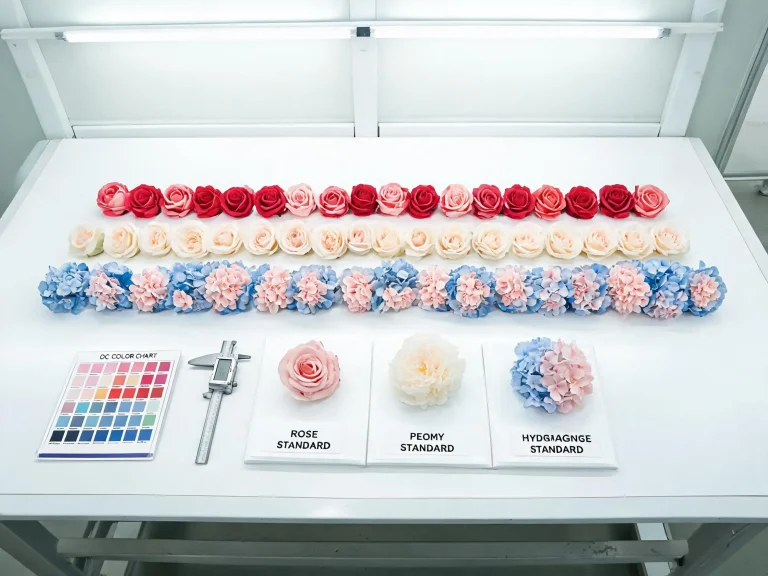

Understanding the Wholesale Artificial Flower Market and Business Potential
The global market for bulk artificial flowers wholesale continues to expand rapidly as commercial enterprises, retail chains, and event planners transition from perishable florals to long-lasting, hyper-realistic alternatives. For importers, regional distributors, and procurement managers, this sector offers reliable turnover, insulated supply chains, and predictable margin structures.
Market Demand and Profit Margins for Distributors
Sustained demand across hospitality, visual merchandising, commercial interior design, and the event sector—especially for clients who arrange artificial wedding flowers—provides distributors with consistent, year-round sales cycles. Unlike live botanicals burdened by cold-chain logistics and rapid spoilage, faux botanicals deliver superior financial predictability.
| Distribution Channel | Target End-User / Application | Typical Gross Margin Range | Primary Demand Drivers |
|---|---|---|---|
| B2B Event Supply | Wedding venues, corporate staging, rental firms | 45% – 65% | Reusability, durability, structural stability |
| Commercial Interior Design | Hotels, restaurants, office spaces, retail displays | 40% – 60% | Zero maintenance, biophilic aesthetics, UV resistance |
| Mass Retail & E-Commerce | Direct-to-consumer home decor, craft retailers | 50% – 70% | Trend-driven palettes, boxed sets, impulse retail |
Key Benefits of Sourcing Artificial Flowers in Bulk
Direct volume procurement unlocks critical commercial advantages for large-scale importers:
- Elimination of Perishability and Spoilage: 0% biological decay during transit, warehousing, and showroom staging ensures full stock monetization.
- Optimized Landed Costs: Consolidating standard shipments via 40HQ containers significantly lowers freight costs per stem.
- Reliable Inventory Availability: Production schedules run independent of natural growing seasons, preventing seasonal stockouts of high-demand varieties.
- Scalable Customization: Bulk purchasing enables custom stem lengths, specialized colorways, and proprietary packaging tailored to local market specifications.
Current Trends in Colors, Formats, and Assortments
Staying ahead of commercial aesthetic trends protects inventory velocity and prevents dead stock:
- Hyper-Realistic Botanical Varieties: High demand for botanical accuracy has made multi-tonal foliage, textured stems, and real touch flowers the industry baseline for premium product lines.
- Trending Color Palettes: Strong pivot toward muted, organic tones—including dusty rose, terracotta, warm taupe, olive green, and desaturated neutrals—replacing high-gloss, saturated artificial dyes.
- Pre-Assembled Commercial Formats: Growth in ready-to-display drop-in bouquets, modular flower wall panels, and pre-bundled floral recipes that reduce labor costs for florists and visual merchandisers.
- Curated Seasonal Assortments: Importers maximize sell-through by ordering balanced assortment cases that pair hero blooms (such as open garden roses, hydrangeas, and peonies) with structural greenery (eucalyptus, olive branches, and ruscus).
Key Material Types and Quality Evaluation Factors
When importing bulk artificial flowers wholesale, product materials dictate your resale margins, shipping durability, and customer satisfaction. A single off-spec batch with frayed fabric or brittle stems can ruin an entire distribution cycle. We evaluate artificial botanicals based on tactile authenticity, environmental resistance, and structural engineering.
Material Guide: Silk, PE, PU, Latex, and Real-Touch Options
Selecting the right raw material depends on whether your clients prioritize price point, tactile realism, or weather durability.
- Silk (Polyester Fabric): The industry standard for volume imports. High-grade synthetic silk takes dye exceptionally well, allowing for nuanced gradients and intricate petal printing. It offers the lowest shipping weight per carton, though raw edges can fray if ultrasonic cutting is not applied.
- PU (Polyurethane): Poured into precision molds, PU produces liquid-smooth, fleshy petals that mimic living botanicals. It holds three-dimensional forms permanently without wrinkling under compression.
- Latex-Coated Cotton: Natural fabric dipped in liquid latex to provide organic weight and a soft, cool-to-the-touch feel. It excels in luxury arrangements but requires climate-controlled storage to prevent surface stickiness over time.
- PE (Polyethylene): The go-to choice for greenery, stems, berries, and outdoor-rated florals. Injection-molded PE offers high tensile strength and seamlessly integrates UV inhibitors directly into the resin.
When outfitting commercial hospitality venues or event rental inventories, comparing real touch vs silk wedding flowers helps you determine whether your catalog needs the tactile realism of coated polymers or the lightweight cost-efficiency of classic textiles.
| Material Type | Tactile Realism | Outdoor Durability | Cost Level | Best Commercial Applications |
|---|---|---|---|---|
| Standard Silk/Pongee | Moderate | Low (indoor only) | Low to Medium | Volume retail, mass floral arrangements, visual merchandising |
| PU Real Touch | Superior | Moderate | High | Premium events, bridal collections, luxury home decor |
| Latex-Coated | High | Low | Medium to High | High-end bouquets, close-up interior displays |
| Molded PE | Moderate | Superior (UV-rated) | Medium | Boxwood walls, hanging vines, exterior planters, architectural greenery |
Evaluating Flower Realism, Stem Construction, and Leaf Density
To ensure high sell-through rates across retail and commercial accounts, we audit three physical attributes on every production run:
- Petal Detailing and Color Layers: Avoid flat, single-tone prints. Look for multi-pass roller printing or manual airbrushing on petal margins. High-tier real touch flowers feature molded micro-veins and gradient undertones near the calyx.
- Stem Engineering: A commercial-grade stem requires a galvanized iron wire core (typically 18 to 22 gauge) wrapped in molded PE or flocked paper tape. The wire must bend smoothly by hand without snapping or puncturing the outer sleeve, maintaining rigid support inside heavy vases.
- Leaf Attachment and Foliage Density: Inspect the junction where branchlets meet the main stem. Cheap items use weak friction fits that drop foliage during unpacking. Specify sonic-welded or glue-injected leaf collars that withstand a minimum 3 to 5 kg pull test. Stems should maintain full foliage density without bare sections showing exposed wire.
Differentiating High-Quality Products from Low-Cost Options
Cutting costs on raw materials always leaves telltale signs that harm commercial distribution. Here is how we separate premium wholesale inventory from budget factory stock:
- Adhesion and Scent: Low-cost suppliers often use generic hot melts that leave stringy glue residue across blooms and off-gas intense chemical odors. High-grade manufacturing uses non-toxic, odorless industrial adhesives cured under temperature control.
- Petal Edge Finish: Entry-level fabrics display loose threads and uneven laser burns around the petal edges. Export-quality silk uses heated die-cutting or polyurethane edge-sealing to prevent fraying during transit.
- UV Stability: Budget green resins turn brittle and fade to blue-grey within weeks of light exposure. Commercial-grade outdoor botanicals blend chemical UV blockers directly into the virgin polymer pellets before extrusion, guaranteeing colorfast performance under commercial lighting or direct sunlight.
Primary Sourcing Hubs and Supplier Types
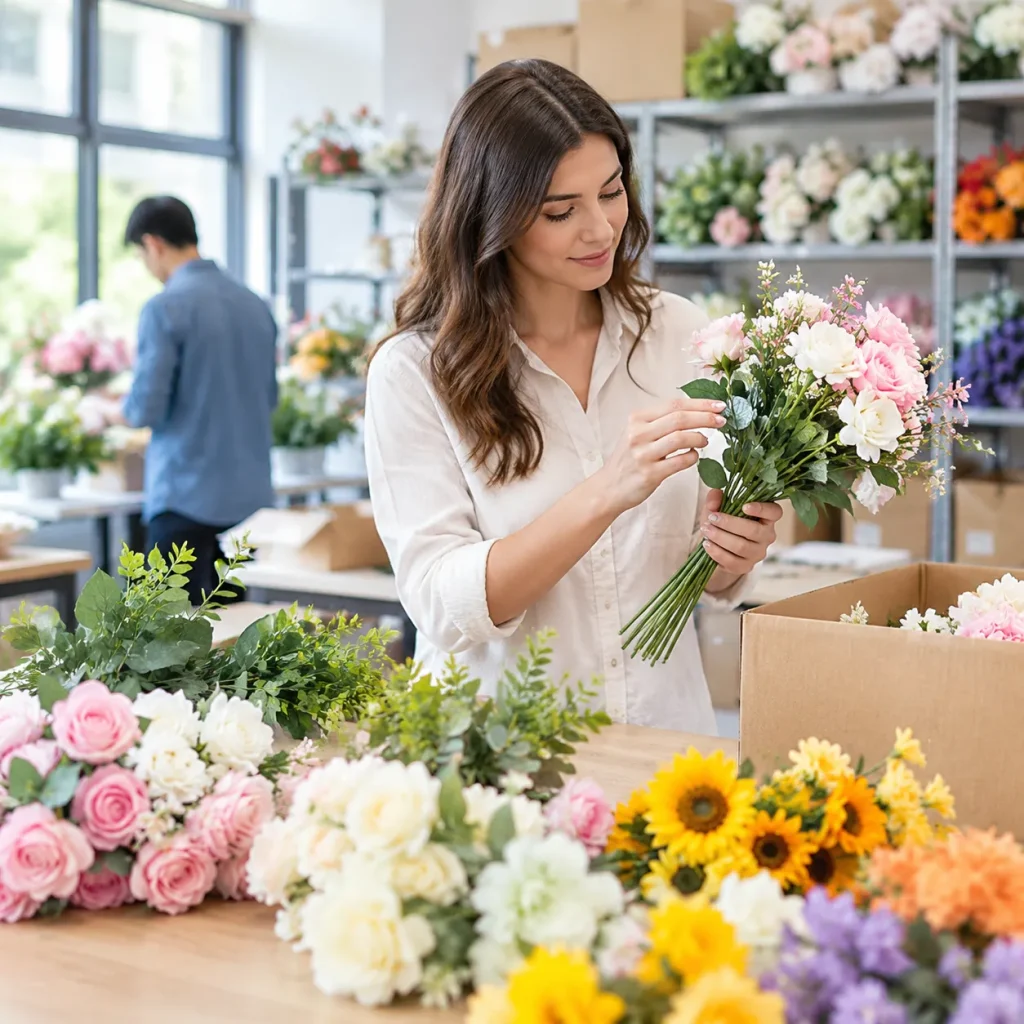
Navigating the supply market for bulk artificial flowers wholesale requires a clear map of industrial clusters and supplier structures. Pinpointing the right manufacturing partner directly impacts your product fidelity, landed margins, and delivery schedules.
Top Sourcing Regions and Wholesale Markets
Production is heavily clustered across distinct manufacturing belts, each tailored to specific price points, product materials, and construction complexities:
- Guangdong Province (Dongguan, Huizhou, Shantou): This is the heart of high-end manufacturing. Dongguan and Huizhou specialize in mid-to-high-end botanical replicas, including intricate real touch flowers made from polyurethane (PU) and premium coated fabrics. Shantou excels in commercial artificial foliage and polyester florals. These facilities maintain sophisticated tooling for realistic petal veining and multi-tone gradient dyeing. Shipments typically route through Shenzhen or Guangzhou ports.
- Zhejiang Province (Yiwu): The Yiwu International Trade Market (District 1) serves as the primary trade hub for budget-friendly catalog items, event decor, and seasonal floral fillers. Suppliers here accommodate lower order thresholds and offer rapid consolidation, making it ideal for standard retail lines.
- Tianjin (Caozili / Wuqing): Caozili is historically known for silk flower fabrication. These factories focus heavily on standard polyester blooms, cemetery florals, and large-volume decorative arrangements where cost efficiency outweighs ultra-realistic detailing.
- Fujian Province (Quanzhou, Xiamen): Fujian manufacturers specialize in floral craft combinations, seasonal holiday arrangements, and polyresin-potted plants. Export logistics commonly operate under FOB Xiamen terms.
| Region | Primary Product Focus | Best Suited For | Typical Export Port |
|---|---|---|---|
| Guangdong | High-tier Real-Touch, PU, high-grade silk | Luxury retail, hospitality, premium decor | Shenzhen / Guangzhou |
| Zhejiang (Yiwu) | Mid/budget polyester flowers, foliage stems | High-turnover retail, dollar stores, volume wholesale | Ningbo / Shanghai |
| Tianjin | Traditional silk flowers, dried-look florals | Large-scale event rentals, mass-market decor | Tianjin (Xingang) |
| Fujian | Potted florals, artificial succulents, crafts | Garden centers, seasonal holiday assortments | FOB Xiamen |
Choosing Between Direct Manufacturers, Trading Companies, and Sourcing Agents
Matching your operational scale with the correct supplier tier prevents miscommunication, unexpected costs, and delays in your supply chain.
- Direct China Factory Supplier:
- Strengths: Direct factory-floor pricing, full control over product materials, and custom mold modifications.
- Weaknesses: Higher MOQ requirements per SKU, limited product variety (a rose specialist rarely makes top-tier faux trees), and less flexible payment terms for new accounts.
- When to use: High-volume runs of core styles where you require strict quality control and predictable unit economics.
- Trading Companies:
- Strengths: Broad catalogs, combined shipments across multiple categories, and smaller minimum orders per design.
- Weaknesses: Adds an 8% to 20% margin markup. Trading companies often restrict direct factory audits and can obscure raw material sourcing details.
- When to use: Building multi-flower collections, wedding event packages, or complex assortments requiring dozens of distinct SKUs in modest volumes.
- Sourcing Agents / Buying Offices:
- Strengths: Boots on the ground. They verify factory certifications, negotiate domestic pricing, supervise packaging compliance, and execute full QC inspections prior to container loading.
- Weaknesses: Sourcing commission fees (typically 3% to 7% of order value).
- When to use: Custom OEM tooling projects, multi-factory consolidation, or when your team cannot physically inspect the production run before final balance payment.
OEM, ODM, and Private Label Customization Services
Scaling a distinctive commercial floral brand relies on customization beyond generic off-the-shelf items.
- OEM Tips for Custom Floral Tooling: When developing exclusive botanical varieties, focus on three technical elements: mold detail, petal count, and inner wire gauge. High-fidelity flowers require custom aluminum molds to stamp realistic petal textures. Always specify UV inhibitors for outdoor-rated plastics and flame-retardant chemistry directly into the raw resin batch rather than relying on spray-on coatings.
- ODM Modifications: You can customize existing factory catalog items without steep mold fees. Adjust stem lengths, switch standard polyester to latex-coated fabrics, change petal color gradients via custom Pantone matching, or alter foliage density to fit your target price point.
- Private Label Guide for Importers: Protect your brand identity by specifying tailored packaging. Request custom barcode hangtags, branded header cards, bespoke retail craft-box sleeves, and standardized master carton printing. For e-commerce distribution, require drop-test-certified inner boxes with molded inserts to keep heavy blooms from crushing during last-mile delivery.
- Sample Request Protocol: Before issuing deposits, run a structured sample request cycle. Approve physical counter-samples for colorfastness, petal bonding strength, and absence of strong chemical odors. These signed samples serve as the binding benchmark for pre-shipment inspections.
Cost Structure and Wholesale Pricing Factors
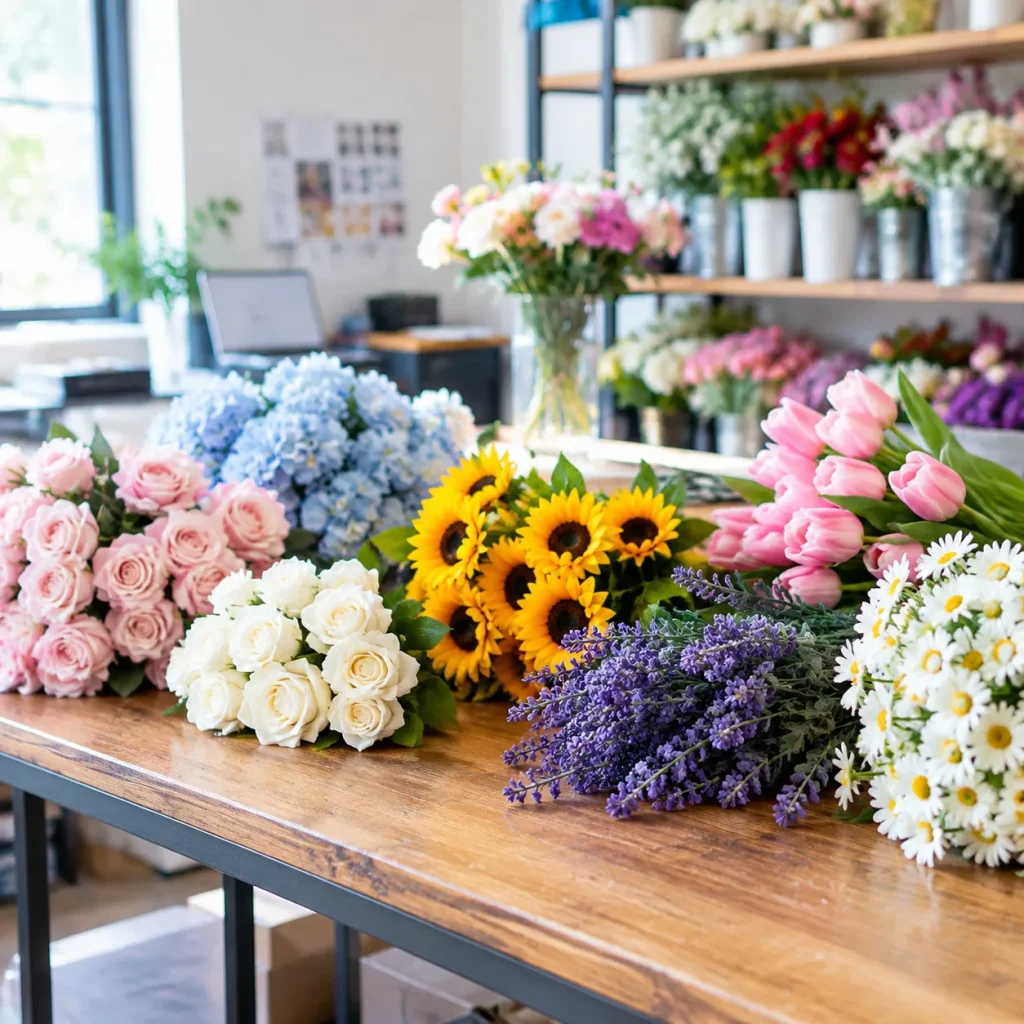
Controlling procurement margins in the bulk artificial flowers wholesale market requires a transparent look at production economics. When I evaluate factory quotes, I look beyond the headline unit price. True landed profitability depends on balancing raw material grading, manual labor time, container utilization, and contract terms like FOB Xiamen versus EXW.
Evaluating the cost structure directly at the factory level protects your margins against surprise surcharges during peak production cycles.
Breakdown of Materials, Manufacturing, and Pot Quality Costs
Every artificial stem, spray, or potted arrangement carries a specific cost distribution across four primary tiers:
| Cost Component | Typical Share of Unit Cost | Key Price Determinants |
|---|---|---|
| Product Materials | 35% – 45% | Fabric grade (polyester silk vs. high-density PU real touch flowers), wire gauge, UV additives, and non-toxic dye formulations. |
| Labor & Assembly | 25% – 30% | Hand-gluing, manual petal curling, vein embossing, and multi-tone gradient spray painting. |
| Potting & Bases | 15% – 20% | Cement-weighted nursery pots, ceramic planters, faux soil, or resin water-look fills. |
| Protective Packaging | 10% – 15% | 5-ply inner cartons, stem binding, protective head sleeves, and master carton burst strength. |
- Petal and foliage density: A single peony head with 60 pressed petals requires twice the tooling cycles and manual assembly time of a basic 25-petal commercial alternative.
- Stem wire gauge and coating: Thick galvanized wire coated in durable PE prevents drooping over time but increases raw material weight and cost compared to recycled PVC alternatives.
- Potting substrates: Potted pre-made botanicals require balanced concrete weighting to prevent tipping, which directly affects product materials and ocean shipping tonnage.
Understanding MOQ Requirements and Production Lead Times
Minimum order quantities (MOQs) in artificial floral manufacturing are set by dye-vat capacities and machine tooling rather than arbitrary supplier thresholds.
- Standard Catalog SKUs: 300 to 500 units per color. These utilize pre-dyed stock fabrics and standard molds, keeping initial capital exposure low.
- Custom Color & OEM Formulations: 1,000 to 3,000 units per style. Fabric mills require minimum fabric weights (usually 1,000+ meters) to run custom Pantone dye-vats.
- Standard Production Lead Times: 30 to 45 days during standard quarters.
- Peak Season Lead Times: 60 to 75 days ahead of major retail quarters and holiday inventory pushes.
Practical OEM tips: When negotiating with a China factory supplier, request split-color allocations against a single stem mold. Sourcing four color variants across a 2,000-piece total mold run meets factory thresholds while maintaining balanced SKU depth across your catalog.
Fair Price Comparison and Supplier Scorecards
Never compare quotes on unit price alone. Evaluate suppliers using a standardized scorecard that weights technical capability, quality control, and compliance alongside unit cost.
| Evaluation Metric | Weight | Key Assessment Criteria |
|---|---|---|
| Price Competitiveness | 30% | Quoted FOB terms, tiered volume price breaks, and tooling amortization. |
| Sample Fidelity | 25% | Accuracy of initial sample request to golden sample, color match, and petal retention. |
| Quality Control System | 25% | Presence of on-line full QC, drop-testing standards, and documented defect tracking. |
| Lead Time Reliability | 20% | Production buffer management, export clearance lead times, and capacity scaling. |
Using this scorecard prevents the common trap of selecting low-bid vendors that yield high return rates, ensuring your commercial floral programs scale reliably and profitably.
Quality Assurance and Risk Management Before Bulk Orders
Securing your margins on bulk artificial flowers wholesale requires proactive risk control long before shipping containers are loaded. When importing floral decor at scale, early quality checks prevent color mismatches, structural failures, and costly inventory write-offs.
Requesting and Evaluating Pre-Production Samples
A formal sample request is the first line of defense before signing off on mass production. Never approve an order based solely on digital photos. When evaluating physical samples, focus on specific structural benchmarks:
- Tactile Quality: Inspect real touch flowers to ensure polyurethane coatings feel supple, realistic, and do not stick or peel under ambient heat.
- Color Fastness and Accuracy: Verify petal dye lots against your target Pantone codes under both natural daylight and commercial retail lighting.
- Adhesion and Pull Tests: Apply moderate force to pull petals, sepals, and leaves away from the central wire stem. Loose glue points indicate poor assembly lines.
- Odor and Residue: Reject samples with heavy petroleum or chemical odors, which point to substandard adhesives that fail import air-quality standards.
- Material Resilience: Check fabric recovery by crushing and reshaping petals; understanding how to clean and maintain silk flowers provides clear baseline criteria for evaluating long-term material stability and washability.
Factory Inspection and Quality Control Protocols
Consistent quality control demands a structured inspection roadmap with your china factory supplier, rather than relying solely on factory self-reporting.
| Inspection Stage | Key Checkpoints | Primary Action |
|---|---|---|
| Pre-Production (PPI) | Raw fabric weight, wire gauge, master batch dyes | Confirm materials match the golden sample. |
| During Production (DUPRO) | Glue cleanliness, leaf placement, stem molding | Conduct checks at 30% completion to catch defects early. |
| Pre-Shipment (PSI) | Carton integrity, label compliance, defect counts | Execute full QC using AQL 2.5 standards before dispatch. |
Always require a carton drop test during final inspection. Stems and flower heads must survive transit impacts without detaching, bending permanently, or puncturing interior packaging.
Preventing Hidden Costs in Wholesale Sourcing
Unplanned expenses can rapidly wipe out wholesale distribution margins. Proactively identify and eliminate these three common cost drivers:
- Dimensional Weight Penalties: Artificial flowers are light but bulky. If factories pack stems loosely, your ocean and domestic freight rates will spike based on volumetric measurements rather than gross weight. Request stem-bending or nested packing methods to optimize carton CBM.
- Tooling and Mold Fees: Custom OEM designs, specialized petal textures, or custom botanic molds carry upfront setup fees. Clarify mold ownership terms in writing so you retain production rights without paying recurring setup charges.
- Defect Reclaim Thresholds: Define clear contractual terms for defective merchandise. Establish that any defect rate exceeding 2% results in direct factory credit or immediate unit replacement on the subsequent container run.
Packaging, Shipping, and International Logistics
Shipping bulk artificial flowers comes down to a fine balance: minimizing volumetric space without crushing delicate blooms. Because artificial flora is lightweight yet bulky, freight calculations rely heavily on cubic meters (CBM) rather than gross weight. We prioritize packaging engineering right at the factory floor to protect your margins and ensure stems arrive retail-ready.
Export Packaging: Carton CBM and Dimensional Weight Optimization
Inefficient packaging drains profitability faster than production scrap. To lower your landed cost per stem, our packing configurations focus on strict CBM optimization:
- Modular Assembly and Detachable Heads: For large blooms and tall arrangements, shipping flower heads detached from stems reduces carton volume by up to 40%. Stems are bundled flat, allowing for significantly higher packing density.
- Stem Bending: Long-stem varieties with flexible wire cores are gently curved to fit compact inner cartons, reducing carton length and outer dimensional weight.
- Master Carton Construction: We pack products into standardized inner boxes before placing them into heavy-duty, 5-ply or 7-ply double-wall corrugated outer cartons (minimum 200# burst strength) to prevent crushing during stacking.
- Container Load Planning: High-cube 40HQ ocean containers are standard for bulk artificial flowers wholesale shipments. Whether routing through FOB Xiamen or other major ports, our cargo loading plans maximize every cubic inch of floor-to-ceiling container space.
Preventing Damage During International Transit
Weeks inside a sea container expose artificial florals to high humidity, rough handling, and thermal fluctuations. We prevent transit damage through precise physical and chemical safeguards:
- Petal Separation Sleeves: Individual heads of delicate fabric blooms and real touch flowers receive micro-perforated polypropylene sleeves or custom cardboard collars to keep petals from tangling, creasing, or flattening.
- Moisture and Mildew Control: Humid transit corridors create condensation inside sealed containers. Every master carton contains high-absorption silica gel packets, and inner polybags are micro-vented to stop moisture entrapment and fabric discoloration.
- Drop-Tested Structural Integrity: Cartons undergo standard ISTA 1A drop tests during final quality control before dispatch from the china factory supplier to confirm that glue joints, foam centers, and wire frameworks remain intact under transit shock.
Navigating Customs, Import Tariffs, and Ocean Freight
Clearing bulk artificial arrangements through international customs requires precise documentation and tariff classification to avoid costly border holds.
| Logistics Component | Specification & Recommendation | Key Considerations |
|---|---|---|
| HS Code Classification | HS Chapter 6702 (Artificial flowers, foliage, and fruit) | Sub-codes depend on primary material (6702.10 for plastics, 6702.90 for textiles/silk/other). |
| Natural Wood Stems | Phytosanitary & Fumigation Certification | Foliage utilizing real, dried, or preserved timber trunks requires official ISPM-15 treatment records. |
| Freight Mode | Full Container Load (FCL) 40HQ | LCL (Less than Container Load) risks crushing from heavier adjacent commercial cargo. |
| Trade Terms | FOB (Free on Board) or CIF (Cost, Insurance, Freight) | FOB grants importers complete routing control and transparent ocean freight negotiation. |
Staying informed on carrier capacity shifts, surcharges, and global shipping policies via industry news helps keep port clearance predictable, schedules tight, and overall inventory turnover stable.
Buying Checklist and Order Execution Strategy
Executing a large-scale artificial flower purchase requires strict attention to procurement milestones. Managing every stage systematically ensures that bulk inventory meets quality standards, lands within budget, and arrives on schedule.
Checklist for Placing Your First Bulk Wholesale Order
Before releasing a production deposit to a china factory supplier, use this step-by-step verification checklist to protect your investment:
- Finalize the Golden Sample: Never start mass production based solely on digital photos. Complete a formal sample request and approve the physical golden sample for petal texture, stem flexibility, and color accuracy under natural lighting.
- Specify Product Materials in Writing: Detail all technical requirements in the purchase agreement, including specific product materials (such as PU real touch flowers, silk fabric density, or UV-resistant PE), wire gauges, and flame-retardant standards.
- Define Commercial & Shipping Terms: Lock in trade terms such as FOB Xiamen, Shanghai, or Ningbo, and clearly specify the agreed unit price, currency, payment milestones (standard 30% deposit / 70% upon bill of lading), and production lead times.
- Confirm Minimum Order Quantities (MOQ): Verify the exact MOQ per SKU, per colorway, and per master carton to avoid unexpected split-pack surcharges.
- Mandate Quality Control Protocols: Include a mandatory full QC inspection clause based on AQL 2.5 standards prior to balance payment and container loading.
- Establish Packaging and Labeling Standards: Set carton crush resistance ratings, inner-box piece counts, barcode placements, and custom branding guidelines for private labeling.
| Procurement Milestone | Core Deliverables | Critical Verification Point |
|---|---|---|
| 1. Spec & Pricing Sign-off | Proforma Invoice & Tech Sheet | Material breakdown, FOB port, lead time |
| 2. Pre-Production Approval | Counter-sample sign-off | Color matching, petal bonding, no chemical odor |
| 3. Mid-Production Review | Mass production photos/video | Color consistency across dye lots |
| 4. Pre-Shipment Inspection | Third-party / Factory QC report | Packaging CBM, pull-test durability, carton drop test |
| 5. Logistics Handover | Bill of Lading & Commercial Docs | Accurate HS codes (Chapter 6702) and packing lists |
Building Bestselling Collections for Retail and E-Commerce
Maximizing inventory turnover requires building a balanced catalog that caters to multiple end-use segments, from e-commerce home decor buyers to commercial event planners.
- Evergreen Foundations (50% of Catalog): Focus on universally high-demand varieties such as real-touch roses, hydrangeas, peonies, and eucalyptus greenery. These lines maintain consistent year-round sales velocity with minimal seasonal markdown risk.
- Event and Hospitality Assortments (30% of Catalog): Stock high-stem florals and neutral-toned palettes specifically curated for buyers who arrange artificial wedding flowers, banquet centerpieces, and corporate displays. Long-stem calla lilies, orchids, and cascading wisteria drive larger order volumes in this category.
- Seasonal & Trend Collections (20% of Catalog): Introduce seasonal colorways—such as warm autumn tones or festive winter palettes—in smaller test batches. Following a structured private label guide and applying custom OEM packaging allows you to brand these limited-run collections for premium retail price points.